Showing posts with label Francis Snowden Brigham. Show all posts

June 7, 2013

Happy 98th Anniversary Ruby & Ganny!

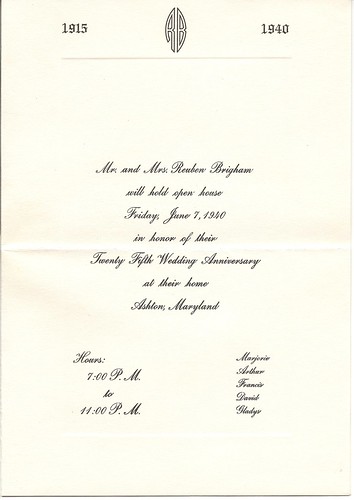
Reuben and Marjorie Brigham silver anniversary invitation

From The Annals of Sandy Spring, Volume V, 1929-1947, edited by Herbert Osburn Stabler, published by American Publishing Co., copyright 1950, p. 181:  On June 7th [1940], the Brigham children gave Reuben and Marjorie a reception in honor of their 25th anniversary.

Reuben and Marjorie Brigham silver anniversary envelope

September 24, 2009

Annals - Volume V

I am in the process of combing through The Annals of Sandy Spring for family history tidbits and started with Volume V, 1929-1947, edited by Herbert Osburn Stabler, published by American Publishing Co., copyright 1950. As always, I welcome corrections and additions. First I have pasted in a couple branches of family tree for your reference, followed by passages from the Annals. For convenience sake, I designated the generations by their relation to me. I have highlighted individuals mentioned in Vol. V of the Annals.

Third Great Grandparents

Lieutenant Nicholas N. SNOWDEN, son of Nicholas SNOWDEN and Elizabeth WARFIELD, b. 7 Apr 1828 at Montpelier in Laurel, MD, d. 6 Jun 1862, near Harrisonburg, VA, married 28 May 1850 at Philadephia, PA, Henrietta STABLER, daughter of William Henry STABLER and Eliza THOMAS, b. 27 Jan 1829, Sandy Spring, MD, d. 21 May 1907, Sandy Spring, MD
1. Emily Roseville SNOWDEN b. 7 Apr 1851, m. Gerard HOPKINS
2. Marion SNOWDEN b. 28 Jun 1853, d. 7 Jan 1857
3. Lucy SNOWDEN b. 13 Mar 1855, m1. ___ LEA, m2. William W. MOORE
4. Helen SNOWDEN b. 7 Apr 1857, m. Dr. Augustus STABLER
5. Francis SNOWDEN b. 19 Mar 1859, d. 11 Sept 1936, m. Fannie Brooke STABLER
6. Mary Thomas SNOWDEN b. 3 Jun 1861, d. 31 Dec 1932, m. Charles Dorsey WARFIELD

John STABLER, son of Thomas Pleasants STABLER and Elizabeth P. BROOKE, b. 13 Apr 1820, married 8 May 1851 Alice Ann BENTLEY, daughter of Joseph E. BENTLEY
1. Florence M. STABLER b. 24 Jun 1852, m. Charles M. BOND
2. Alice Evelyn STABLER b. 14 Aug 1854
3. Cora STABLER b. 6 Oct 1856
4. Anna B. STABLER b. 24 Feb 1859
5. Frances "Fannie" Brooke STABLER b. 25 Oct 1860, d. 25 Mar 1943, m. Francis SNOWDEN
6. Eliza Brooke STABLER b. 15 May 1863
7. John STABLER Jr. b. 15 Nov 1865
8. Alice Bentley STABLER b. 8 Jan 1868
9. Evangeline STABLER m. William H. GILPIN

Second Great Grandparents

Arthur Amber BRIGHAM, son of John Winslow BRIGHAM and Mary Rebecca PUTNAM, b. 6 Oct 1856, Marlboro, MA, d. 12 Nov 1938, Lakeland, FL, married 6 Oct 1881 Charlotte Warren BRIGHAM, daughter of Dennison BRIGHAM and Sarah WEEKS, b. 1857, Marlboro, MA, d. 1933
1. Reuben BRIGHAM b. 13 Dec 1887, d. 6 Dec 1946, m. Marjorie SNOWDEN
2. Ruth BRIGHAM b. 12 Sept 1892

Francis "Frank" SNOWDEN, son of Lt. Nicholas SNOWDEN and Henrietta STABLER, b. 19 Mar 1859, d. 11 Sept 1936, married 18 May 1886 Frances "Fannie" Brooke STABLER, daughter of John STABLER and Alice Ann BENTLEY, b. 15 Oct 1860, d. 25 Mar 1943
1. Elsie Brooke SNOWDEN b. 4 Mar 1887, d. 21 Dec 1945
2. Miriam SNOWDEN b. 15 Apr 1891, d. Nov 1950, m1. Samuel P. THOMAS, m2. James H. LAMPTON
3. Edward SNOWDEN b. 13 Dec 1893, m. Nellie KELLEY
4. Anna McFarland SNOWDEN b. 27 Jul 1896, m. Louis Theodore "Doc" BUSSLER
5. Marjorie SNOWDEN b. 1888, d. 1970, m. Reuben BRIGHAM

Great Grandparents

Reuben BRIGHAM, son of Arthur Amber BRIGHAM and Charlotte Warren BRIGHAM, b. 13 Dec 1887, Marlboro, MA, d. 6 Dec 1946, Chicago, IL, married 7 Jun 1915 at Ingleside in Sandy Spring, MD, Marjorie SNOWDEN, daughter of Frances SNOWDEN and Francis Brooke STABLER, b. 1888, d. 1970
1. David Lewis BRIGHAM b. 1916, d. Oct 1999, Olney, MD, m. 28 Dec 1938 Gladys BEALL b. 7 Oct 1915, d. 29 Dec 2008, Mt. Airy, MD
2. Francis Snowden BRIGHAM, deceased, m. Dorothy LEMON, deceased
3. Marjorie Amber BRIGHAM b. 22 Feb 1922, still living, m. 18 July 1944 Robert Whitney MILLER, deceased
4. Arthur Putnam BRIGHAM b. 1928, d. 22 Jan 1992, Bella Vista, AR, m. Helen CASE, still living

Excerpts from The Annals of Sandy Spring, Volume V, 1929-1947:

p. 16 - Sept. 15 [1930] a large number of people visited the unusual and beautiful detura plants of Elsie Snowden at Engleside [sic]. During the night of bloom two plants had 90 bell-shaped blooms, six inches in length and three inches in diameter, and very fragrant. There was also a night-blooming cereus with fourteen blooms. The garden lovers of the neighborhood visiting this unusual sight felt that this was the most beautiful display of floraculture ever seen in Sandy Spring.

p. 47 - Mary Snowden Warfield was my friend and the friendship strengthened and deepened with the years. As a homemaker, a mother, and a friend she lived a life so fully ripe in good deeds, she must have been tenderly gathered into the great Garner House of the Lord when on December 31 [1932], with the dying year, she passed into the Great Beyond. She lied in the family lot in Oak Grove Cemetery at Glenwood, Maryland.

p. 84 - The obituary for Miriam Snowden Lampton is tucked into the pages here, about October 1935. Although the article contains no date of death, I believe that she died in November 1950. She was married to Samuel P. Thomas and widowed before she wed James H. Lampton. The text of the notice is as follows:

Miriam Lampton Buried Saturday. Burial services were held Saturday for Mrs. Miriam Snowden Lampton, of Ashton and Washington, D.C., at the Friends Meeting House, Sandy Spring. A native of Montgomery County, Mrs. Lampton was employed by the Atomic Energy Commission in Washington. She was the daughter of the late Mr. and Mrs. Francis Snowden, of Ashton. Death came at the Sibley hospital in Washington last week, following a brief illness, brought on by a severe brain hemorrhage. Mrs. Lampton is survived by her two sons, Evan S. Thomas, of Seattle, Washington, and Edward P. Thomas, Wheaton. She is also survied by two sisters, Mrs. Reuben Brigham [Marjorie], of Ashton, and Mrs. Louis T. Bussler [Anna], also of Ashton, and a brother, Edward Snowden of Sandy Spring.

p. 106-7 - Francis Snowden was born at "Avondale" near Laurel, Maryland, March 19, 1859. His grandmother, Elizabeth Warfield Snowden, tiring of so large an establishment as "Montepelier" [sic] divided her possessions among her six sons and six daughters reserving five hundred acres of the manor upon which she built a brick house and asked her son Nicholas to live with her. He was to inherit it at her death. In 1850 he took his bride Henrietta Stabler there. When the Civil War was declared, Captain [sic] Nicholas Snowden and his militia company joined the Confederate ranks, providing their own horses and uniforms. He lost his life in an engagement at Harrisonburg, Virginia, June 6, 1862. Three years later his mother died and Henrietta Snowden returned to her birthplace, Sandy Spring, to occupy, with her five children "Ingleside" a house her father Wm. Henry Stabler built for her and there Francis was reared.

He married Fannie Brooke [Frances] Stabler May 18, 1886 in Sandy Spring Meeting House. They went to "Ingleside" to live with his mother where their four daughters and one son were born. There they lived for a little over fifty years. He passed away on September 11, 1936, and was laid to rest at Sandy Spring. (E.T.S.)

p. 137 - E. Clifton Thomas bought a tract of woodland adjoining Ashton from Fanny B. Snowden [1937-8].

p. 148-9 - Nov. 12th [1938]. Arthur A. Brigham, aged 82 years, died in Lakeland, Florida, where he had gone to spend the winter; his remains were interred a few days later in Woodside Cemetery. Mr. Brigham was a Past Master of Massachusetts State Grange. For a time he was Professor of Agriculture at the Imperial College of Agriculture at Sapporo, Japan. Later he received the degree of Doctor of Philosophy at Goettingen, Germany. He then occupied the position of Professor of Agriculture at the Experiment State of Rhode Island. He went from there to Ithaca, New York, where he became general manager of the Cornell Incubator Co. he then moved his family to South Dakota where he became the organizer and first Principal of the South Dakota School of Agriculture. Mr. Brigham was largely responsible for the establishment of the Grange in Rhode Island and was instrumental in the formation of two in Florida.

p. 151 - Dec. 28th [1938]--David Lewis Brigham, son of Reuben and Marjorie Brigham and Gladys Beall, daughter of Forest and the late Flora Dill Beall were married in Rockville. The young people have gone to live in Des Moines, Iowa, where David has a position.

p. 181 - On June 7th [1940], the Brigham children gave Reuben and Marjorie a reception in honor of their 25th anniversary.

p. 194 - [April 1941] About this time Reuben and Marjorie Brigham returned from an extensive trip to Mexico and the South.

p. 198-9 - [August 1941] Through Reuben Brigham, it seems the Agricultural Dept. has become interested in the Sandy Spring Community as an advanced social and agricultural section; so for several months they have been preparing an educational film based on our past history and the efforts of the three farmers' clubs and especially the Farmers' Convention from which so much of our advancement in agriculture has emanated. They have taken shots on farms at Rockland, Plainfield, Willow Grove, The Highlands, Oakley, The Briars and perhaps some others along with some of the old Meeting House and Community House where the first Farmers Convention was held over seventy years ago. When completed and rounded out it ought to make a very creditable showing of the records and accomplishments of Sandy Spring farmers.

p. 205 - Augustus Stabler was born at Roslyn, near Brighton August 25th, 1858. As a young man he took courses at Johns Hopkins University and studied medicine at Howard University. On September 18th, 1884 he married Helen Snowden and went to live in Lawrence, Mass. where he practiced medicine. In Sept. 1888, he returned to Roslyn to live, bringing his wife and two children, Isabel and Austin. He practiced medicine and farmed until the summer of 1911, where he entered the service of the U.S. Dept. of Agriculture. In 1915 he went to Fairfax County, Va. where he operated a nursery with his son Henry. He died March 27th [1942] and is survived by five children, Isabel S. Moore, Sydney Snowden, Henry, Nicholas Snowden and N. Graham Stabler. Interment was at Woodside. (E.H.L.)

p. 207-8 - Fannie B. Snowden and daughter Elsie again spent the winter [1941-2] at the home of her daughter and son-in-law Louis and Anna Bussler at Ashton.

p. 210 - I feel it is fitting that we should record here the names of our neighborhood boys who joined one or another branch of our Nation's services: Francis Brigham... [1941-2]

p. 224 - Frances Brooke Snowden, daughter of John and Alice Bentley Stabler, was born Oct. 15th, 1860 at "Oreola" near Brookeville, Md. She received her education in the schools of Philadelphia. Returning to Sandy Spring she made her home at "Harewood" with her cousins Arthur and Anna Stabler, and from there was married May 18th, 1886, to Francis Snowden. As a bride, she went to Ingleside where she lived until her death on march 25th, 1943, having survived her husband by over five years. She faithfully performed the duties of the busy wife and helpmate and gave the loving care of a mother to their five children. The latter years of her life were spent as a partial invalid. She was always cheerful and uncomplaining, an outstanding example to all who knew her. (M.S.M.)

p. 252 - The following is a list of the Community young men that are now serving their country in one or another branch of the armed forces. These are the boys and men that went in during the year [1943-4] or who were inadvertently missed from last year's record: ...Francis Snowden...David Brigham...Francis Brigham...

p. 257-8 - On July 18th [1944] Marjorie Amber, daughter of Reuben and Marjorie S. Brigham was married to Staff Sgt. Robert Whittley Miller, son of Mr. and Mrs. Robert W. Miller of Silver Spring, Maryland. Later, Sgt. Miller was stationed at Ascension Island with the weather division of the Army Air Corps and Marjorie went to Camp Swift for basic training in the Army Nursing Corps as a 2nd Lieutenant. During July the Fifth War Loan was largely oversubscribed by the Sandy Spring section.

p. 260 - On Aug. 28th [1944] a telegram was received by Louis T. Bussler from the War Department bearing the sad news that his nephew Paul Bussler had been killed in action in France on Aug. 11th.

p. 262 - Oct 21st [1944] Virginia, daughter of Edward and Nellie Kelley Snowden was married to Mr. Rudolph Bouquet, son of Mr. and Mrs. G.P. Bouquet of Houma, La.

p. 271 - A list of Sherwood High School graduates discloses the fact that during the past year [1944-5] the following have entered the service of their country:...Marjorie Brigham Miller.

p. 278 - About this time [Sept. 1945] Marjorie Brigham Miller went to the Pacific Coast in her capacity as an Army nurse; she sailed from New York by way of the Panama Canal.

p. 279 - Elsie Brooke Snowden passed away Dec. 21st [1945] after a brief illness at Garfield Hospital in Washington. The daughter of Francis and Frances Brooke Snowden, she was born at Ingleside March 4th, 1887. After training at the Corcoran Art School in Washington and the Academy of Fine Arts in Philadelphia, she twice traveled abroad on scholarships from the Philadelphia Academy. She received recognition in the United States and Europe for her landscape and portrait paintings, and the Corcoran School honored her with its Annual Gold Medal. Interment was in the Friends Meeting House grounds at Sandy Spring. (E.T.S.)

p. 301 - On Dec. 6th [1946] Reuben Brigham died suddenly on a trip to the midwest where he had gone in his capacity as an extension worker in the Agriculture Department. This huge, somewhat gaunt, somewhat Lincolnesque fellow, who lumbered along like an old fashioned farm wagon, was biological mass of electronically fortified atoms. Born in Marlboro, Mass. in 1887, he grew up all over the world, wherever his father taught agriculture. In 1908 he graduated from the University of Maryland and spent the next five years farming in this state.

In 1913 he turned up as secretary and general assistant to Pres. Harry J. Patterson of the University of Maryland. Two years later he became Maryland's extension editor and also assumed charge of boys 4-H Club work. In 1917 he entered USDA to develop visual and editorial materials for extension work. He himself developed into a human institution. But all that doesn't say it. He was more than a man. He was a force. Warm, human, friendly, dynamic, as earthy as his pure farmer name, he was known all over the nation where many times he seemed to be the Department of Agriculture personified. No place was too small, no individual too inconsequential for him. He passed none by. Indefatigable, boundless in energy, incredible in production, outstanding career employee, Nature's own nobleman, a product of the soil--is interests never once flagged--until Dec. 6th when Reuben Brigham took off for more boundless horizons where his restless mind will find many unfinished tasks. (From USDA.)

p. 308 - On Friday, Feb. 7 [1947], a "Talent Show" was presented in the [Sherwood] auditorium. Barbara Woodward won first prize with a ballet dance, Dolores Beall, who sang and accompanied herself on the piano won second prize and the Heil sisters were third when they harmonized "Ol' Buttermilk Skies."

p. 308-9 - Among the transfers of property during the year [1946-7]... Robert W. and Margery [sic] Brigham Miller built and moved into a house on a portion of the Brigham property...
August 20, 2009

Profiles of Reuben Brigham


From the website of the Association for Communication Excellence in Agriculture, Natural Resources, and Life and Human Sciences:

The Reuben Brigham Award is offered in memory of Reuben Brigham (1887-1946), a native of Marlboro, Mass., and graduate of the University of Maryland. He served as an extension editor and 4-H Club agent in Maryland and was called to the Federal Extension Service office in 1917 to develop an editorial and visual aids service for extension editors. Brigham traveled the nation, conferring with editors and directors, and helped states develop their own editorial offices as separate units.

He organized the American Association of Agricultural College Editors and served as its president, secretary and treasurer. He established the Extension Service Review in 1939 and participated in the Farm and Home Hour of the National Broadcasting Company. During the Depression, he helped develop action agencies of the Agricultural Adjustment Administration. As head of a regional section of the AAA information office, he ensured that extension staffs were involved in that organization’s information plans. He later was appointed assistant director of the Federal Extension Service and was associated with extension directors, the land-grant college association and policy-making committees of the U.S. Department of Agriculture. Brigham died in Chicago while attending a meeting at the National 4-H Club Congress.

The Reuben Brigham Award, established in 1947, is reserved for a communicator, including a public relations or advertising professional, who has made a a major contribution in the field of agriculture, natural resources, or life and human sciences at the regional, national or international level. Active and retired members of ACE, a land-grant college or university staff, or USDA staffs are not eligible for the award. (Click for a list of past winners.)

* * * * *

A profile from the ACE retirees website:

Reuben Brigham. President 1924-25. U. S. Department of Agriculture

Reuben Brigham was born Dec. 13, 1887 in Marlboro, Mass. He was the son of a farmer and professor of agriculture. He graduated from the Maryland Agricultural College (later the University of Maryland) in 1908. For the next five years he operated a farm in Maryland, then returned to the university in 1913 to serve as secretary of Alumni Affairs to the university president. When the Smith-Lever Act established the extension service later that year, he joined the Maryland College of Agriculture staff where he was their first extension editor and 4-H club agent.

In 1917 he joined the U.S. Department of Agriculture’s extension service in Washington, D.C. to develop an editorial and visual-aids service for extension editors. He also started the Extension Service Review magazine in 1930.

During the depression years of the 1930s, he joined the Agricultural Adjustment Administration (AAA) where he was in charge of a regional section of the “Triple A” information office. In this position, he “saw to it that the college editors of the nation were used in all information plans and that the local state extension staff, including the editor, was not by-passed. . ..” He later returned to the extension service and was named assistant director.

He died unexpectedly Dec. 6, 1946 while attending the National 4-H Club Congress in Chicago—one week short of his 59th birthday. Following Reuben Brigham’s death, Past President Frank Jeter (North Carolina) said, “Brigham has as much to do with the successful formation and organization of the American Association of Agricultural College Editors as any other one single person.” Since 1947 AAACE/ACE has given the annual Reuben Brigham Award to honor the contributions in agricultural, home economics, and rural communication of a person outside its membership—the organization’s highest award.

* * * * *

And finally the culmination of a recent research project by Scout Jim Bikel titled "Reuben Brigham: Legend Unveiled," dated March 21, 2009, about the founder and first scoutmaster of Boy Scout Troop #264. He presented his project to the 10th annual Montgomery County gathering for National History Day. I had the pleasure of meeting Jim Bikel--a very nice young man--and I think he did a great job here. I have inserted two minor corrections into the text, which appear within brackets and are italicized:

Introduction

As part of a competition for an extracurricular activity known as National History Day, I did a research project on Mr. Reuben Brigham, commonly known to you as the troop’s founder. National History Day is a competition that is similar to a science fair for history. This year, the NHD had a theme of legacy. They recommended that we each pick a person from any period of history to research, and to focus on their lasting impact on the community, nation or world. While others focused on more well-known characters such as John Wilkes Booth, Walter Reed or Dr. Bird, I chose a lesser known character that I knew impacted me. Reuben Brigham, I knew, founded our scout troop in 1927. I knew nothing else about him, and didn’t expect much. Instead, I found he left much more than a scout troop behind. Be aware that I write about only what I was able to find out, and it is likely that some information is missing.

Childhood Years and Early Background

Reuben Brigham was born in Marlboro, Massachusetts, on December 13, 1887. His early years were spent growing up on a farm. His father taught him the farming methods himself, and Reuben also went to many different schools. He grew up not only in America, but in several other nations, including Germany and Japan. Sometime, he moved to the United States again and settled in Ashton, MD. He went to the University of Maryland (known back then as the Maryland Agricultural College), and he then graduated in 1908. After his graduation, he farmed for five years until his life became interesting.

Parcel Post

Ever wonder how that package came to your door? Ever wonder who started the Parcel Post? Farmers in the United States long wanted a government parcel service, due to the high prices that private companies would require. You often had two choices with items. You could pay more than half the worth to ship your products east or you could let them rot while you haul them yourself over the Appalachian Mountains. The reverse was true with getting something. If you needed, say, a Model-T car-to-tractor conversion kit so you could use a gasoline engine instead of a stubborn mule to plow your fields, you would have to pay the evil railroad companies more than twice the value of the kit to ship it to where you could pick it up, or you could take the dangerous route east yourself to get the part, leaving your farm unattended and spending hard-earned cash on gasoline and such. The National Grange, a large nationwide organization that farmers used to unionize and advocate for farmer rights, had turned a blind eye to it. Mr. Brigham, of the Olney Grange, wasn’t about to let a good plan go to waste. (The Olney Grange was a branch of the Maryland Grange, a branch of the National Grange, which was formed as unions won battles in industry while envious farmers still struggled.) By encouraging congressman David J. Lewis to test its soundness in Congress, he managed to get it through. There were many points at which the Honorable David J. Lewis admitted he felt like giving up. He said that through Mr. Brigham’s bottomless enthusiasm, he managed to gain enough support to get the legislation passed. Farmers and city folks nationwide loved it. A farmer now did not have to spend near as much to get a stupid part, so he was able to expand his farm more rapidly, and the customers ended up paying much less due to the significantly lowered shipping costs. The only downfall to this legislation was that the railroad companies were going bankrupt (eventually leading some of them to unite as CSX.) So next time you receive a package at the door, think about how it all started-from that same man who founded our scout troop.

The Agricultural Department

Ever hear about the United States Department of Agriculture? (You know, that government agency that inspects meat, leaving a sticker on it if it looks good enough?) It was originally started to help farmers and ranchers become educated about their actions, work, and sanitation, and to clean up the meat-packing industry scandals. According to the Agricultural Extension Service, he was called to the Department of Agriculture in 1917 to take charge of producing visual and editorial materials. After serving a year in the army, he returned to the agricultural department. He worked in the Agricultural Extension Service, which was created for the purpose of gathering the above stated materials. In the Extension service, he created a magazine which is still published today, known as the Agriculture Extension Service Review. In 1933, he was placed in the Agricultural Adjustment Administration (remember learning about FDR’s New Deal in History Class?). There he developed a regional contact division, which was used as a public relations committee for the AAA and other depression and wartime agencies. (The AAA was later deemed unconstitutional by the Supreme Court.) Another of his extension jobs was being the 4-H Club leader to Maryland, and he eventually became the top figure in the national 4-H Club. The 4-H Club was an organization founded to teach farm youth the basics of farming and how to do it the right way (preventing another Dust Bowl), and to give farm youth a proper education and upbringing. In his work, Mr. Brigham was very dedicated. He would not give the people he needed to contact a telephone call or a proper letter, but instead he would go out there in person and talk and become friendly with the farmers. He was so attached to his work that he died of an ailment when he went out west to contact a few farmers in 1946.

Mr. Brigham and War

In 1918, a year after Reuben joined the Agricultural Department, he joined the army. He fought as one of millions of “doughboys” fighting in WWI for the Allies against the Central Powers. He only fought for a single year, and not too much is known about his actions, most likely because he was no one of high rank. Reuben’s children were all involved in WWII. His son, David Brigham, served in the Pacific, and his other son served in Europe. His daughter became an army nurse. Mr. Brigham understood how the Axis Powers saw the war from their point of view, instead of just the Allied view, having grown up in Japan and Germany himself.

Mr. Brigham and Family

As stated before, Mr. Brigham’s father had dragged Reuben’s childhood all over the world. Mr. Brigham married Marjorie Snowden on June 7, 1915 at Ingleside (Queen Anne's County, MD) [*correction by Barb - Ingleside was the name of Francis Snowden's home located south of Ashton, MD, on what is now Route 650 New Hampshire Avenue]. Mr. and Mrs. Brigham were devout Quakers, and played a role in the Sandy Spring Friends group. As stated before, Reuben had three children. His first son, David Lewis Brigham, was named after Congressman David J. Lewis, a friend to Mr. Brigham. He had a second son, whose name I cannot find [*correction by Barb - Reuben had two more sons named Francis Snowden Brigham and Arthur P. Brigham, both of whom are deceased]. His daughter, born on February 22, 1922, was named after her mother, to become Marjorie Amber Brigham [now Marjorie Brigham Miller]. Marjorie, (the daughter) is still alive. She lives in Vermont, and helped me with my MDHD project. David Brigham married Gladys Beall in Rockville on December 28, 1938. David and Gladys Brigham had a son, who was also named David. This David Brigham, grandson of Reuben Brigham, is the person who has his name on a plaque on the bell structure in front of Sherwood High School. David Brigham Sr. died in 1999, and he had written a memoir about his father for the troop (also posted on the website). Reuben, having died in 1946, is buried on his property in Ashton next to his wife, Marjorie.

Property and House

Mr. Brigham bought his property from Francis Snowden in 1921. He built his house, named Glyndon, and that house still stands. It is visible at 1022 Olney-Sandy Spring Road, Ashton, MD. Our troop used to do our annual primitive there, but due to a problem with the neighbors, we have used the Haviland property as a substitute. (I will not discuss this too much, because I am bound to get it wrong, not knowing all the details.) On his property, he and his wife are buried as previously stated side-by-side. Besides the grave markers, there are different memorials honoring him, one from the American Legion Post #68, (which he helped found after WWI and which is still the sponsor of the troop), another from the University of Maryland Class of ’08 (1908, not 2008), and another from “Friends in Agriculture”.

Brigham and Youth

Mr. Brigham believed in the proper upbringing of rural youth. This is visible through the 4-H clubs he was involved with. David Brigham Senior has already written his brief memoir about the Troop’s history, so I shall not restate that. To access it, follow this link.

* * * * *

Correspondence from the late 1940's between Reuben "Shorty" Brigham and John William Firor are housed in Duke University Library's collection of Firor's papers, indexed here but not available online. Measuring in at 6'6" tall, this "Shorty" must be our Reuben.

December 24, 2008

The Sandy Spring Museum

I visited the Sandy Spring Museum last week and snapped a few photographs. I remember when the museum first opened in a small brick home in Olney. My father, David A. Brigham, was a charter member and somehow designated as the first person that the security company called every time the wind blew and set off the alarm. Many a late night got dressed and drove up over to reset the security system. It must have been a little like being in the fire department again. Both he and my grandfather lived to see the new facility open. And it is really a testament to the Sandy Spring community. I want to share some of our family's images from the museum and the website. Many of these appear in the book Sandy Spring Legacy, which you can purchase directly from the museum. (I also found used copies listed on Amazon.)

This photograph and text about Reuben Brigham is part of an exhibit at the museum. Reuben and David J. Lewis worked together on the Parcel Post bill.

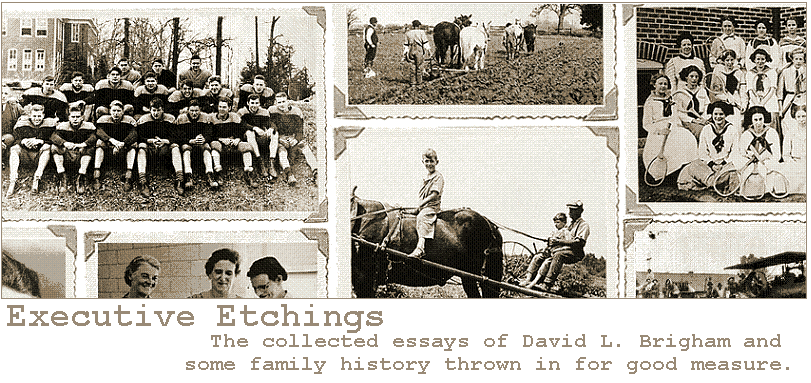
Sherwood's first tackle football team, fielded in 1944, smiles despite a disastrous initial season. Coached by math teacher Dwight Hurley, left, they are, front row from left: Mike Conner, Jimmy Frenzel, Willard Derrick, Fred Fry, Tom Benson, Calvert Heil, Keith Himebaugh, and Charlie Morris; second row, William Miller, Kyle Cantwell, John Johns, Robert Franklin, Sonny Johns, Louis Bussler, and Arthur Brigham; back row, Dick Kimmel, Pete Black, and David Haviland.

Girls' tennis flourished at youthful Sherwood High of 1910. The players are, front row from left: Polly Janney (Shields), Lydia Chichester (Laird), and Katherine Nichols; second row, Deb Iddings (Willson), Barbara Miller, Irene Kimler (Miller), Helen Barnes, Annie Miller, Edith Shoemaker; third row, Gladys Brooke (Tumbleson), Lydia Tatum, Anna Snowden (Bussler), and Henrietta Waters.

Iced tea for 2,300 is brewed by Gladys Brigham (center) and Anne Gilpin (right) for the forty-third annual Hospital Supper and Bazaar in 1964. Mrs. Gilpin's sister, Mrs. C. Jones from England, observes. Staged by the Woman's Board, the annual supper and bazaar has been a major community event for nearly 80 years.

A childhood recollection of David L. Brigham, born 1916: "I curried the horses, mucked the stalls, milked the cows, slopped the pigs, fed the chickens, loaded the manure spreader, and cleared the barnyard and chicken house." In this photograph David L. Brigham rides up front and younger brother Francis Snowden Brigham shares the hay rake with grandfather Francis Snowden at Ingleside in 1922.

Two teams pull plows at Ingleside, just south of Ashton; the 1855 home stands at right. Gussie Holland works the plow in foreground, while Ingleside farmer Francis Snowden supervises the annual plowing ritual.

The museum website had photographs of David, Arthur, and Francis Brigham but none of their sister Marjorie.