 From the website of the Association for Communication Excellence in Agriculture, Natural Resources, and Life and Human Sciences
:
The Reuben Brigham Award is offered in memory of Reuben Brigham (1887-1946), a native of Marlboro, Mass., and graduate of the University of Maryland. He served as an extension editor and 4-H Club agent in Maryland and was called to the Federal Extension Service office in 1917 to develop an editorial and visual aids service for extension editors. Brigham traveled the nation, conferring with editors and directors, and helped states develop their own editorial offices as separate units.
He organized the American Association of Agricultural College Editors and served as its president, secretary and treasurer. He established the Extension Service Review in 1939 and participated in the Farm and Home Hour of the National Broadcasting Company. During the Depression, he helped develop action agencies of the Agricultural Adjustment Administration. As head of a regional section of the AAA information office, he ensured that extension staffs were involved in that organization’s information plans. He later was appointed assistant director of the Federal Extension Service and was associated with extension directors, the land-grant college association and policy-making committees of the U.S. Department of Agriculture. Brigham died in Chicago while attending a meeting at the National 4-H Club Congress.
The Reuben Brigham Award, established in 1947, is reserved for a communicator, including a public relations or advertising professional, who has made a a major contribution in the field of agriculture, natural resources, or life and human sciences at the regional, national or international level. Active and retired members of ACE, a land-grant college or university staff, or USDA staffs are not eligible for the award. (Click for a
list of past winners.)
* * * * *
A profile from the ACE retirees website:
Reuben Brigham. President 1924-25. U. S. Department of Agriculture
Reuben Brigham was born Dec. 13, 1887 in Marlboro, Mass. He was the son of a farmer and professor of agriculture. He graduated from the Maryland Agricultural College (later the University of Maryland) in 1908. For the next five years he operated a farm in Maryland, then returned to the university in 1913 to serve as secretary of Alumni Affairs to the university president. When the Smith-Lever Act established the extension service later that year, he joined the Maryland College of Agriculture staff where he was their first extension editor and 4-H club agent.
In 1917 he joined the U.S. Department of Agriculture’s extension service in Washington, D.C. to develop an editorial and visual-aids service for extension editors. He also started the Extension Service Review magazine in 1930.
During the depression years of the 1930s, he joined the Agricultural Adjustment Administration (AAA) where he was in charge of a regional section of the “Triple A” information office. In this position, he “saw to it that the college editors of the nation were used in all information plans and that the local state extension staff, including the editor, was not by-passed. . ..” He later returned to the extension service and was named assistant director.
He died unexpectedly Dec. 6, 1946 while attending the National 4-H Club Congress in Chicago—one week short of his 59th birthday. Following Reuben Brigham’s death, Past President Frank Jeter (North Carolina) said, “Brigham has as much to do with the successful formation and organization of the American Association of Agricultural College Editors as any other one single person.” Since 1947 AAACE/ACE has given the annual Reuben Brigham Award to honor the contributions in agricultural, home economics, and rural communication of a person outside its membership—the organization’s highest award.
* * * * *
And finally the culmination of a recent research project by Scout Jim Bikel titled "Reuben Brigham: Legend Unveiled," dated March 21, 2009, about the founder and first scoutmaster of Boy Scout Troop #264. He presented his project to the 10th annual Montgomery County gathering for National History Day. I had the pleasure of meeting Jim Bikel--a very nice young man--and I think he did a great job here. I have inserted two minor corrections into the text, which appear within brackets and are italicized:
IntroductionAs part of a competition for an extracurricular activity known as National History Day, I did a research project on Mr. Reuben Brigham, commonly known to you as the troop’s founder. National History Day is a competition that is similar to a science fair for history. This year, the NHD had a theme of legacy. They recommended that we each pick a person from any period of history to research, and to focus on their lasting impact on the community, nation or world. While others focused on more well-known characters such as John Wilkes Booth, Walter Reed or Dr. Bird, I chose a lesser known character that I knew impacted me. Reuben Brigham, I knew, founded our scout troop in 1927. I knew nothing else about him, and didn’t expect much. Instead, I found he left much more than a scout troop behind. Be aware that I write about only what I was able to find out, and it is likely that some information is missing.
Childhood Years and Early BackgroundReuben Brigham was born in Marlboro, Massachusetts, on December 13, 1887. His early years were spent growing up on a farm. His father taught him the farming methods himself, and Reuben also went to many different schools. He grew up not only in America, but in several other nations, including Germany and Japan. Sometime, he moved to the United States again and settled in Ashton, MD. He went to the University of Maryland (known back then as the Maryland Agricultural College), and he then graduated in 1908. After his graduation, he farmed for five years until his life became interesting.
Parcel PostEver wonder how that package came to your door? Ever wonder who started the Parcel Post? Farmers in the United States long wanted a government parcel service, due to the high prices that private companies would require. You often had two choices with items. You could pay more than half the worth to ship your products east or you could let them rot while you haul them yourself over the Appalachian Mountains. The reverse was true with getting something. If you needed, say, a Model-T car-to-tractor conversion kit so you could use a gasoline engine instead of a stubborn mule to plow your fields, you would have to pay the evil railroad companies more than twice the value of the kit to ship it to where you could pick it up, or you could take the dangerous route east yourself to get the part, leaving your farm unattended and spending hard-earned cash on gasoline and such. The National Grange, a large nationwide organization that farmers used to unionize and advocate for farmer rights, had turned a blind eye to it. Mr. Brigham, of the Olney Grange, wasn’t about to let a good plan go to waste. (The Olney Grange was a branch of the Maryland Grange, a branch of the National Grange, which was formed as unions won battles in industry while envious farmers still struggled.) By encouraging congressman David J. Lewis to test its soundness in Congress, he managed to get it through. There were many points at which the Honorable David J. Lewis admitted he felt like giving up. He said that through Mr. Brigham’s bottomless enthusiasm, he managed to gain enough support to get the legislation passed. Farmers and city folks nationwide loved it. A farmer now did not have to spend near as much to get a stupid part, so he was able to expand his farm more rapidly, and the customers ended up paying much less due to the significantly lowered shipping costs. The only downfall to this legislation was that the railroad companies were going bankrupt (eventually leading some of them to unite as CSX.) So next time you receive a package at the door, think about how it all started-from that same man who founded our scout troop.
The Agricultural DepartmentEver hear about the United States Department of Agriculture? (You know, that government agency that inspects meat, leaving a sticker on it if it looks good enough?) It was originally started to help farmers and ranchers become educated about their actions, work, and sanitation, and to clean up the meat-packing industry scandals. According to the Agricultural Extension Service, he was called to the Department of Agriculture in 1917 to take charge of producing visual and editorial materials. After serving a year in the army, he returned to the agricultural department. He worked in the Agricultural Extension Service, which was created for the purpose of gathering the above stated materials. In the Extension service, he created a magazine which is still published today, known as the Agriculture Extension Service Review. In 1933, he was placed in the Agricultural Adjustment Administration (remember learning about FDR’s New Deal in History Class?). There he developed a regional contact division, which was used as a public relations committee for the AAA and other depression and wartime agencies. (The AAA was later deemed unconstitutional by the Supreme Court.) Another of his extension jobs was being the 4-H Club leader to Maryland, and he eventually became the top figure in the national 4-H Club. The 4-H Club was an organization founded to teach farm youth the basics of farming and how to do it the right way (preventing another Dust Bowl), and to give farm youth a proper education and upbringing. In his work, Mr. Brigham was very dedicated. He would not give the people he needed to contact a telephone call or a proper letter, but instead he would go out there in person and talk and become friendly with the farmers. He was so attached to his work that he died of an ailment when he went out west to contact a few farmers in 1946.
Mr. Brigham and WarIn 1918, a year after Reuben joined the Agricultural Department, he joined the army. He fought as one of millions of “doughboys” fighting in WWI for the Allies against the Central Powers. He only fought for a single year, and not too much is known about his actions, most likely because he was no one of high rank. Reuben’s children were all involved in WWII. His son, David Brigham, served in the Pacific, and his other son served in Europe. His daughter became an army nurse. Mr. Brigham understood how the Axis Powers saw the war from their point of view, instead of just the Allied view, having grown up in Japan and Germany himself.
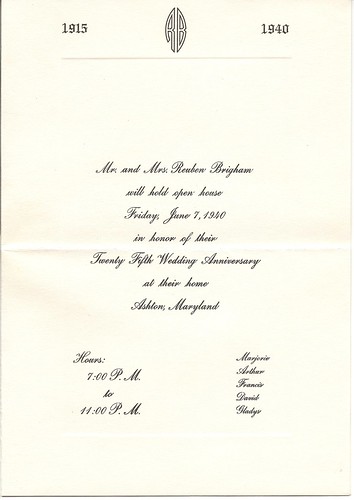
Mr. Brigham and FamilyAs stated before, Mr. Brigham’s father had dragged Reuben’s childhood all over the world. Mr. Brigham married Marjorie Snowden on June 7, 1915 at Ingleside
(Queen Anne's County, MD) [
*correction by Barb - Ingleside was the name of Francis Snowden's home located south of Ashton, MD, on what is now Route 650 New Hampshire Avenue]. Mr. and Mrs. Brigham were devout Quakers, and played a role in the Sandy Spring Friends group. As stated before, Reuben had three children. His first son, David Lewis Brigham, was named after Congressman David J. Lewis, a friend to Mr. Brigham. He had a second son, whose name I cannot find [
*correction by Barb - Reuben had two more sons named Francis Snowden Brigham and Arthur P. Brigham, both of whom are deceased]. His daughter, born on February 22, 1922, was named after her mother, to become Marjorie Amber Brigham [
now Marjorie Brigham Miller]. Marjorie, (the daughter) is still alive. She lives in Vermont, and helped me with my MDHD project. David Brigham married Gladys Beall in Rockville on December 28, 1938. David and Gladys Brigham had a son, who was also named David. This David Brigham, grandson of Reuben Brigham, is the person who has his name on a plaque on the bell structure in front of Sherwood High School. David Brigham Sr. died in 1999, and he had written a memoir about his father for the troop (also posted on the website). Reuben, having died in 1946, is buried on his property in Ashton next to his wife, Marjorie.
Property and HouseMr. Brigham bought his property from Francis Snowden in 1921. He built his house, named Glyndon, and that house still stands. It is visible at 1022 Olney-Sandy Spring Road, Ashton, MD. Our troop used to do our annual primitive there, but due to a problem with the neighbors, we have used the Haviland property as a substitute. (I will not discuss this too much, because I am bound to get it wrong, not knowing all the details.) On his property, he and his wife are buried as previously stated side-by-side. Besides the grave markers, there are different memorials honoring him, one from the American Legion Post #68, (which he helped found after WWI and which is still the sponsor of the troop), another from the University of Maryland Class of ’08 (1908, not 2008), and another from “Friends in Agriculture”.
Brigham and YouthMr. Brigham believed in the proper upbringing of rural youth. This is visible through the 4-H clubs he was involved with. David Brigham Senior has already written his brief memoir about the Troop’s history, so I shall not restate that. To access it, follow
this link.
* * * * *
Correspondence from the late 1940's between Reuben "Shorty" Brigham and John William Firor are housed in Duke University Library's collection of Firor's papers, indexed here but not available online. Measuring in at 6'6" tall, this "Shorty" must be our Reuben.


 This photograph and text about Reuben Brigham is part of an exhibit at the museum. Reuben and David J. Lewis worked together on the Parcel Post bill.


